A working library · v0.4 · May 2026
The Codex. सामत्वार्थ — prosperity in rhythm
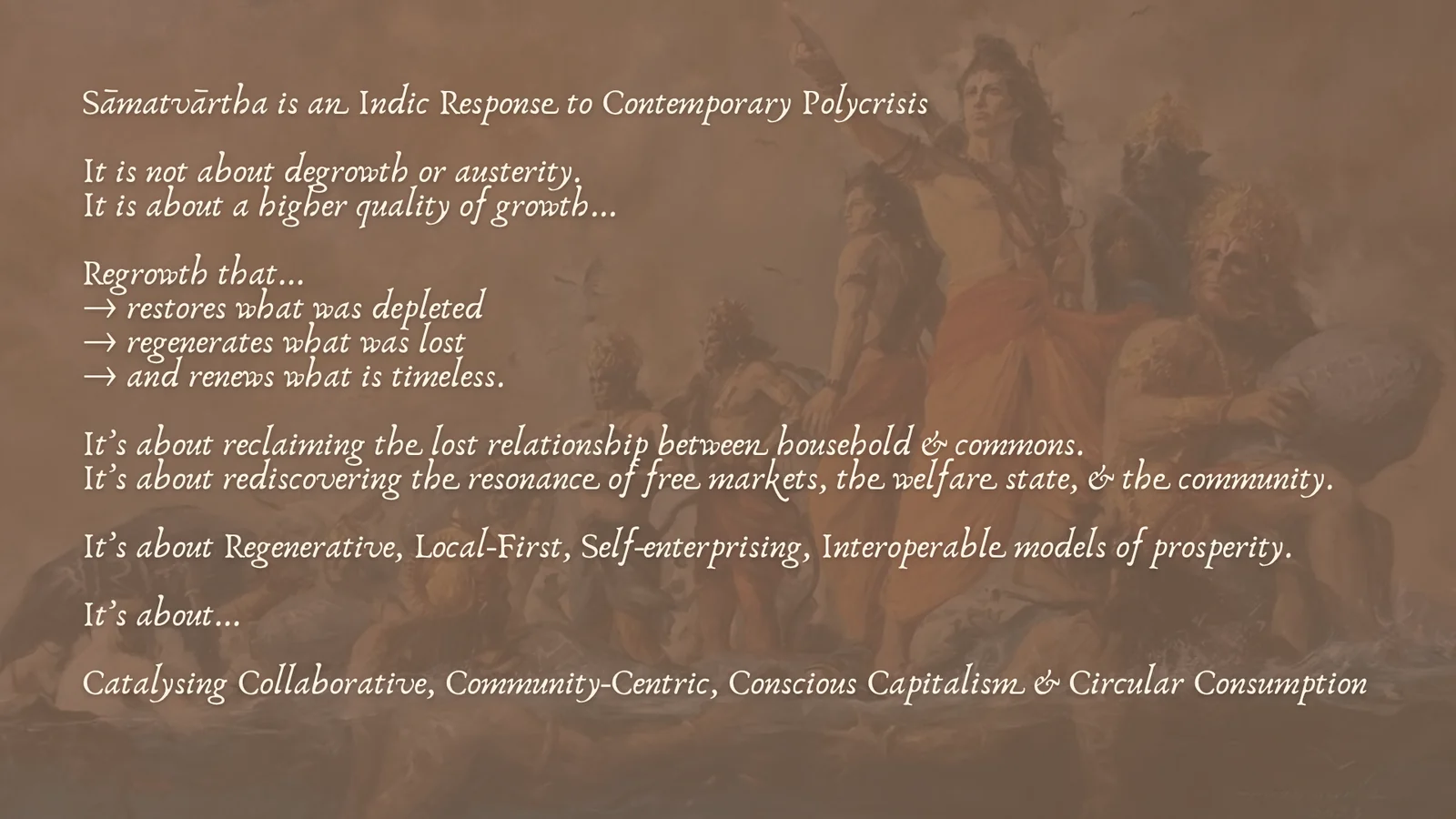
A regenerative architecture met against the sharpest diagnoses of why coordination keeps failing. The synthesis is the work.
A regenerative architecture met against the sharpest diagnoses of why coordination keeps failing. The synthesis is the work.
Start anywhere. The Codex is a constellation, not a sequence — four strata of atomic essays, all internally cross-linked. The Indic Spine carries the architecture. The Build shows what gets built when the architecture is taken seriously. The Bridges translate to and from the Western diagnostic canon. The Western Canon is the bench — the diagnoses worth carrying, not the court that grants permission. Same direction, deeper substrate, executable architecture. Each essay makes two moves: first, a source-faithful account of the thinker or book; second, the Sāmatvārtha reading of what that diagnosis unlocks.
The spine. Four essays that name the frame, the ledger, the diagnosis it produces, and the inflection it meets. Read this stratum to understand what the studio is actually building and the substrate it is being built on.
Prosperity sought in rhythm.
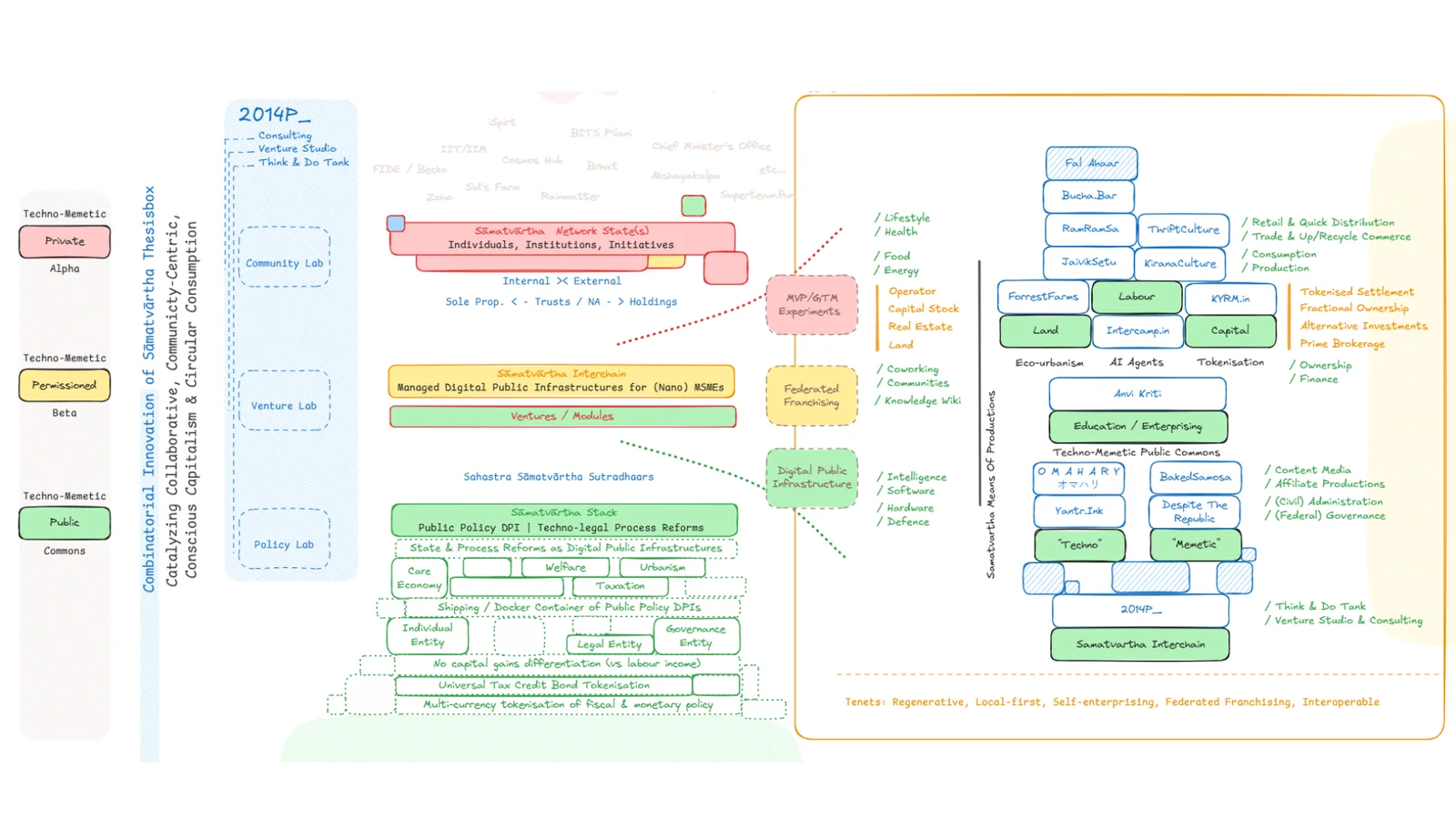
The full architecture, end to end. Spine, diagnosis, three substrates, the build, the invitation.
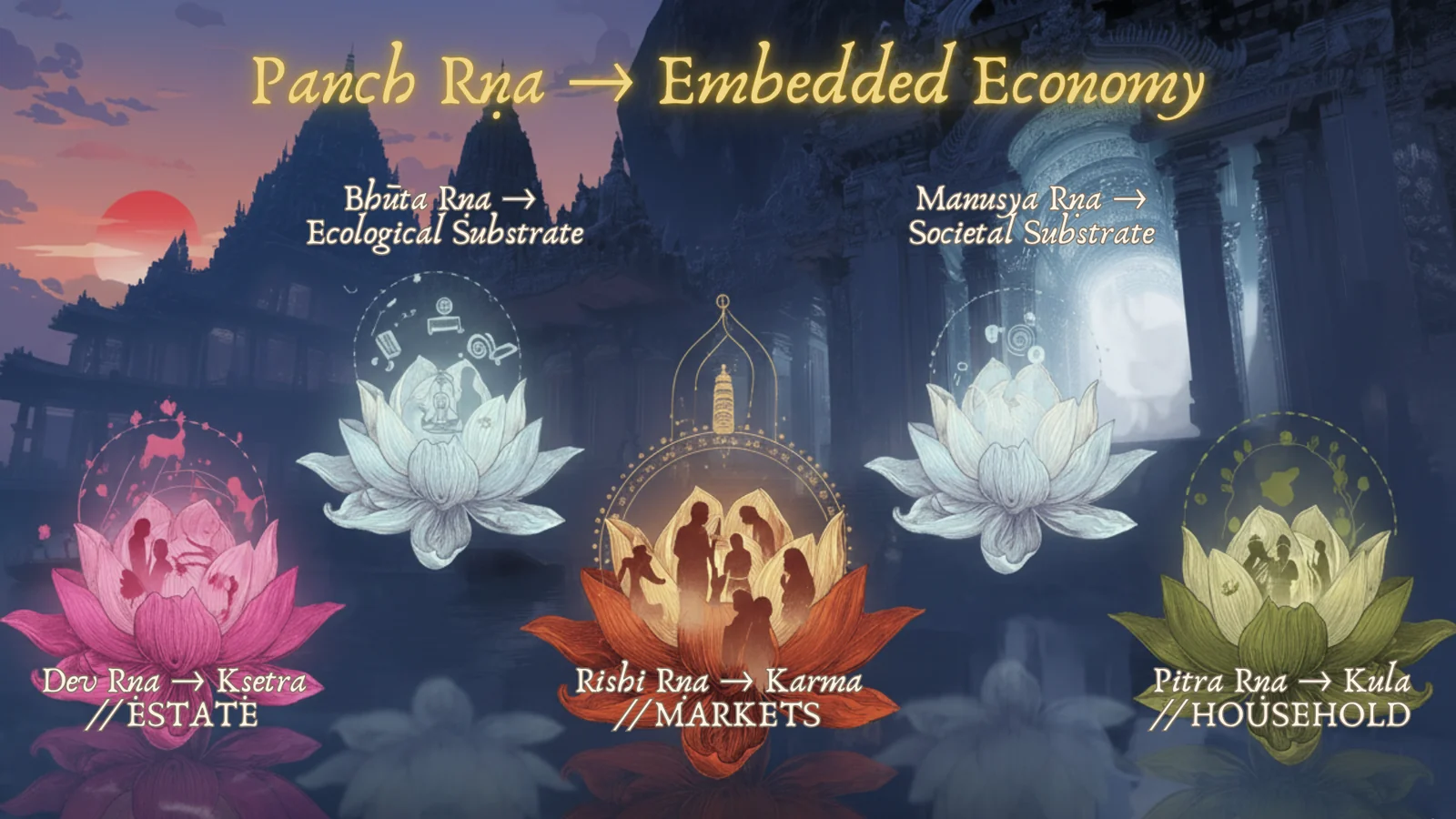
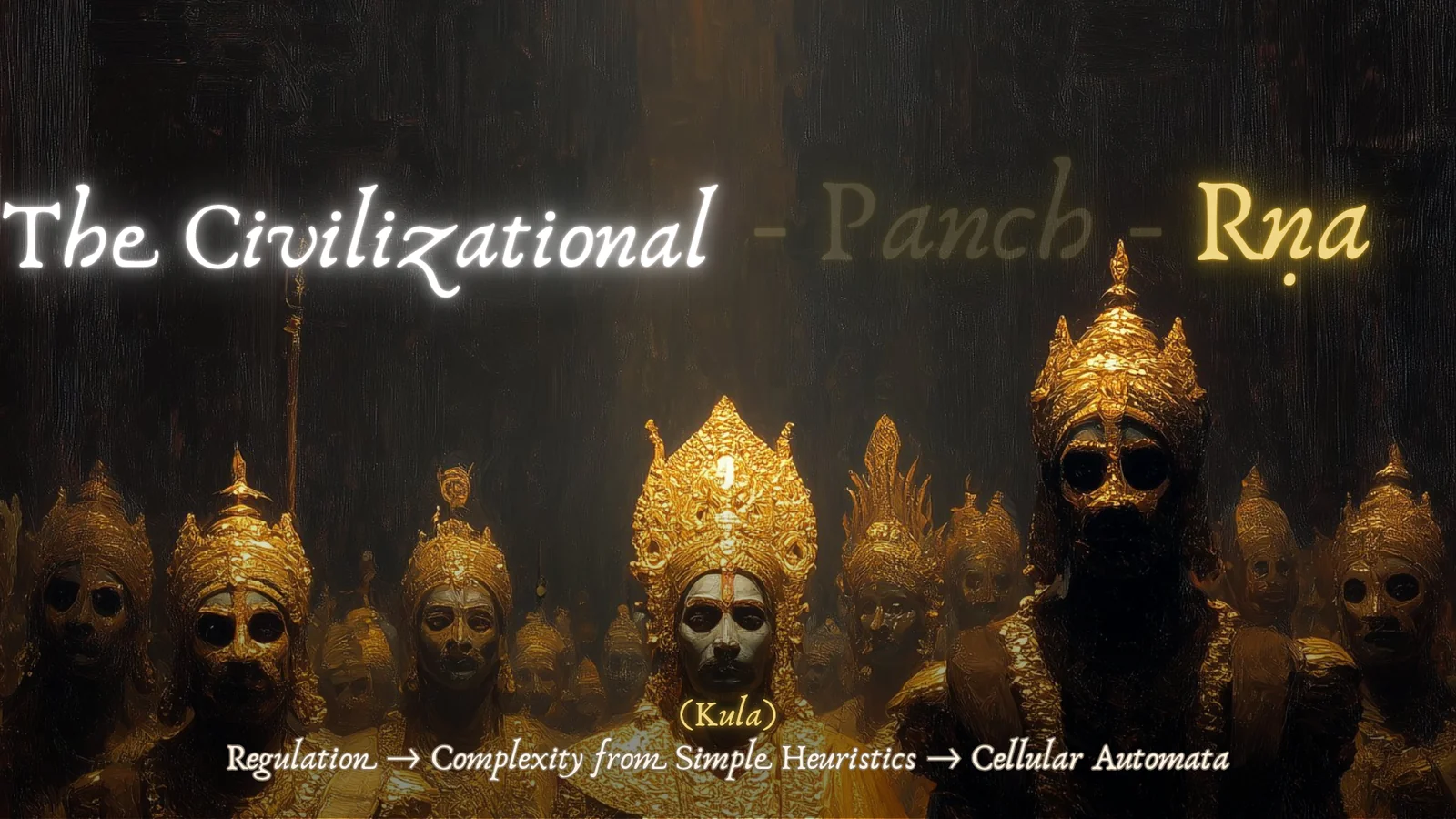
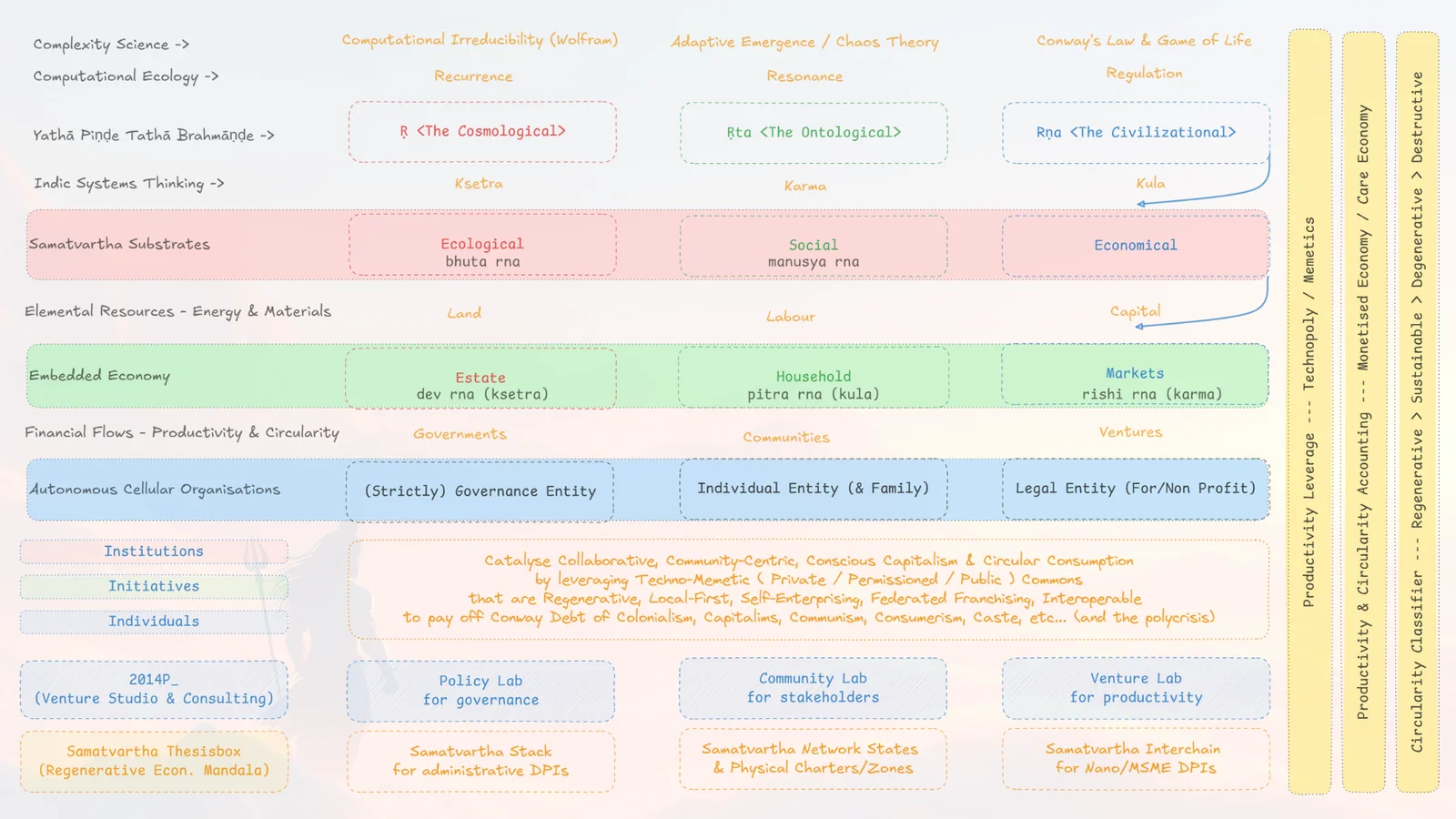
The five civilisational debts modern accounting cannot ledger.
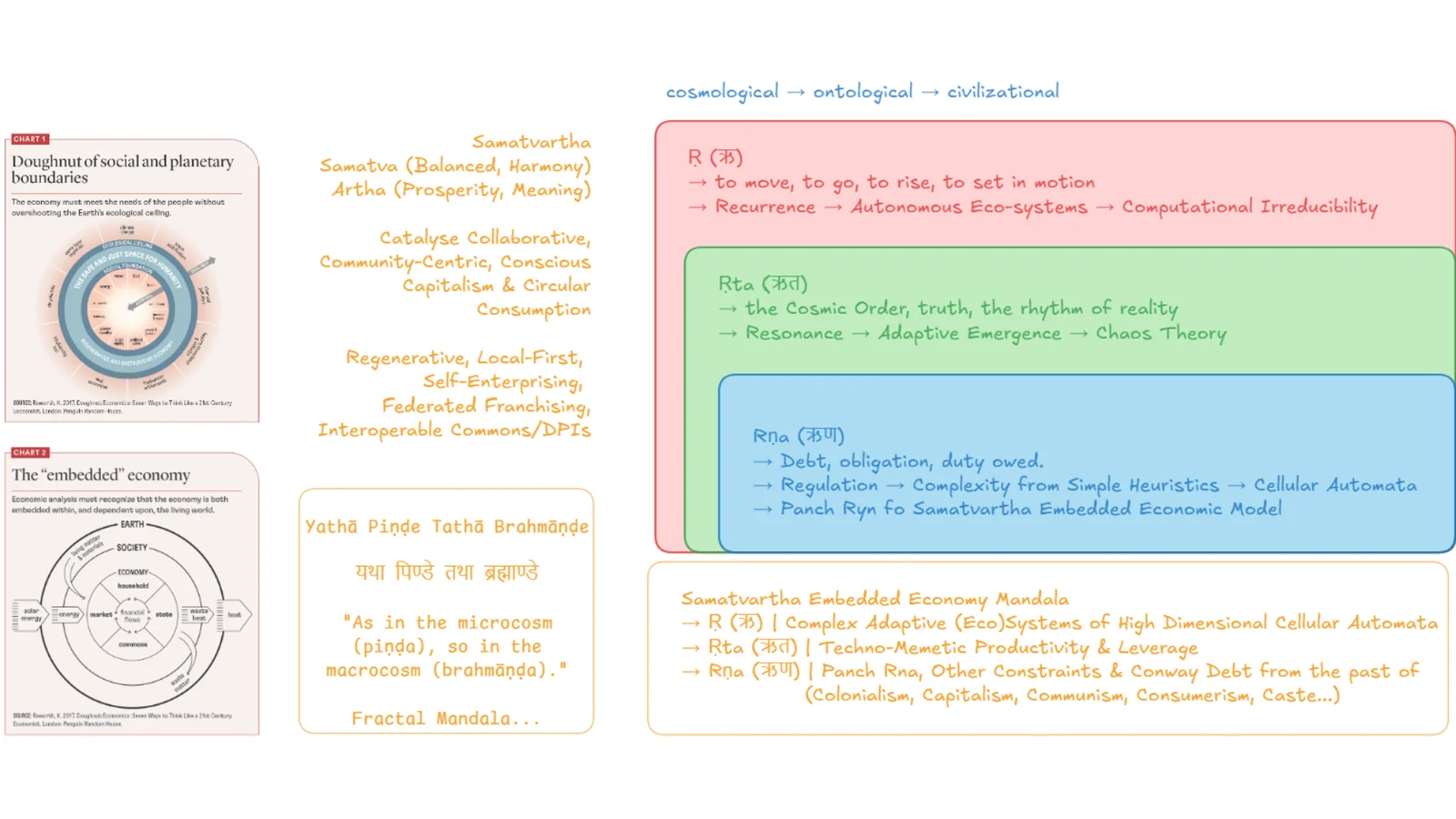
Bhūta · Manuṣya · Pitra · Ṛṣi · Dev. Goodhart-resistant by construction. The Indic deepening of Doughnut.
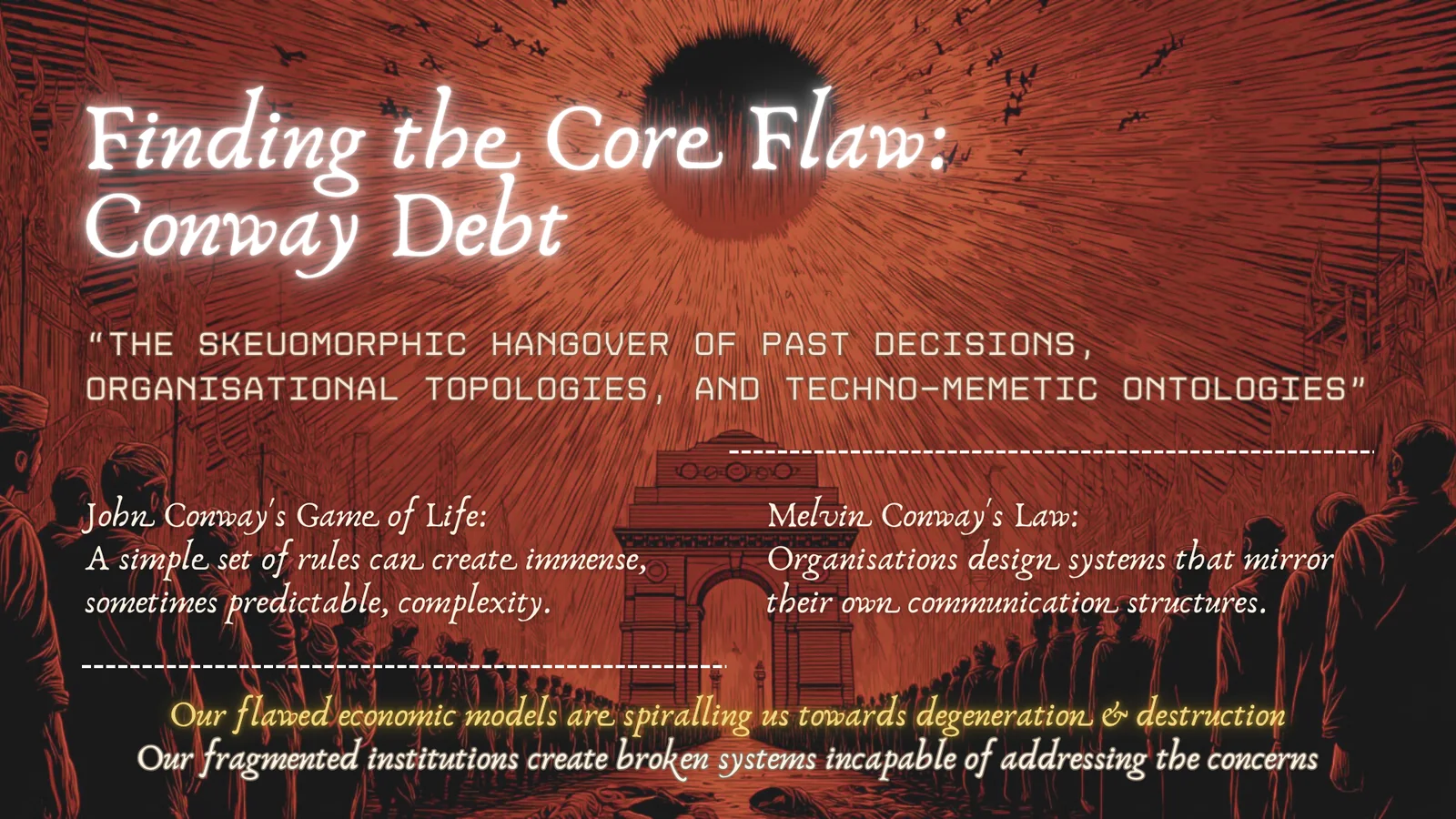
The compounding hangover of every prior org chart.
Conway's Law × Conway's Game of Life. The operational naming for what the West calls metacrisis.
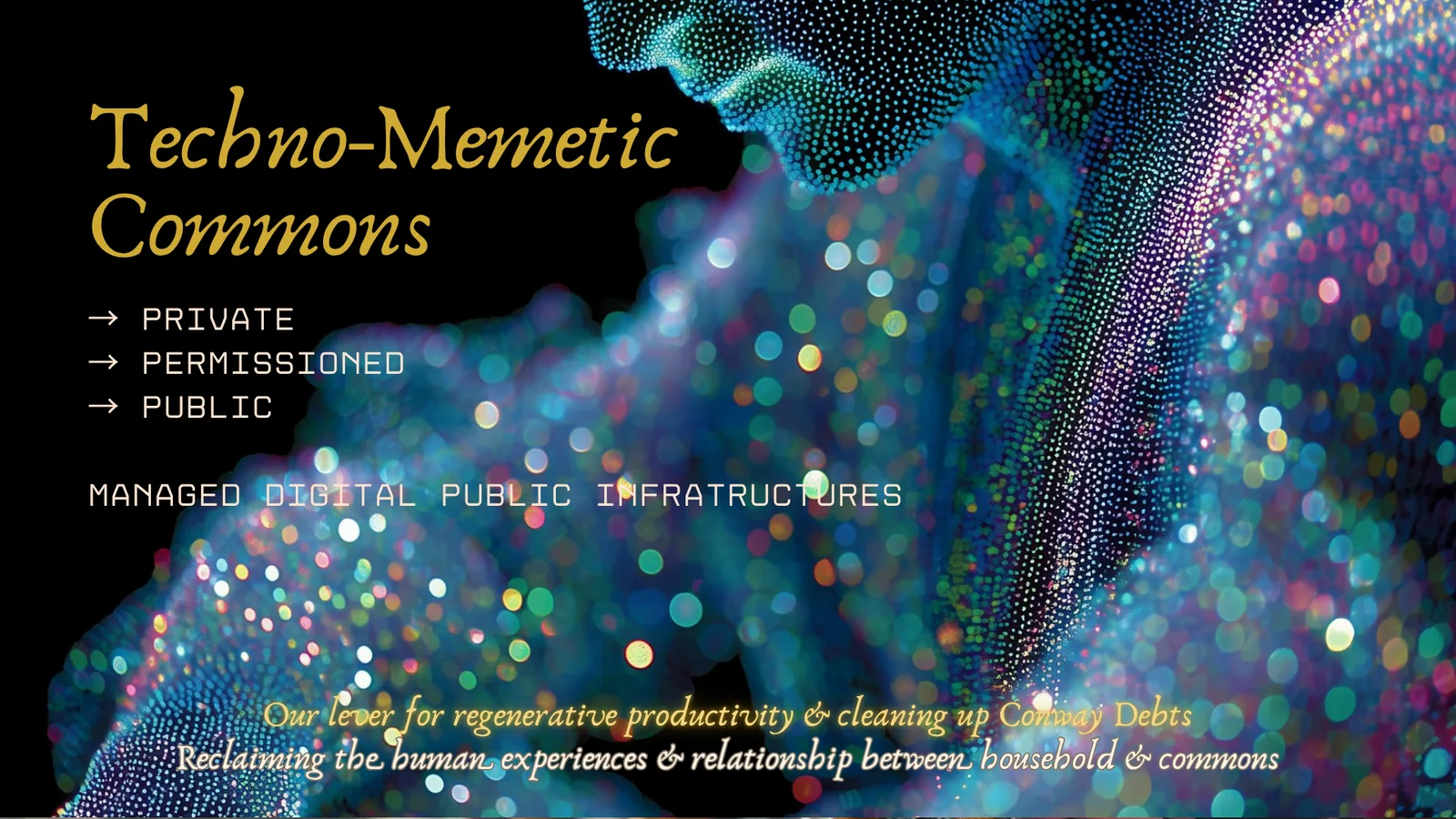
Same technology, different substrate, different audit.
Refusal of the doomer/accelerationist binary. The Yayati-Singularity critique of UBI.
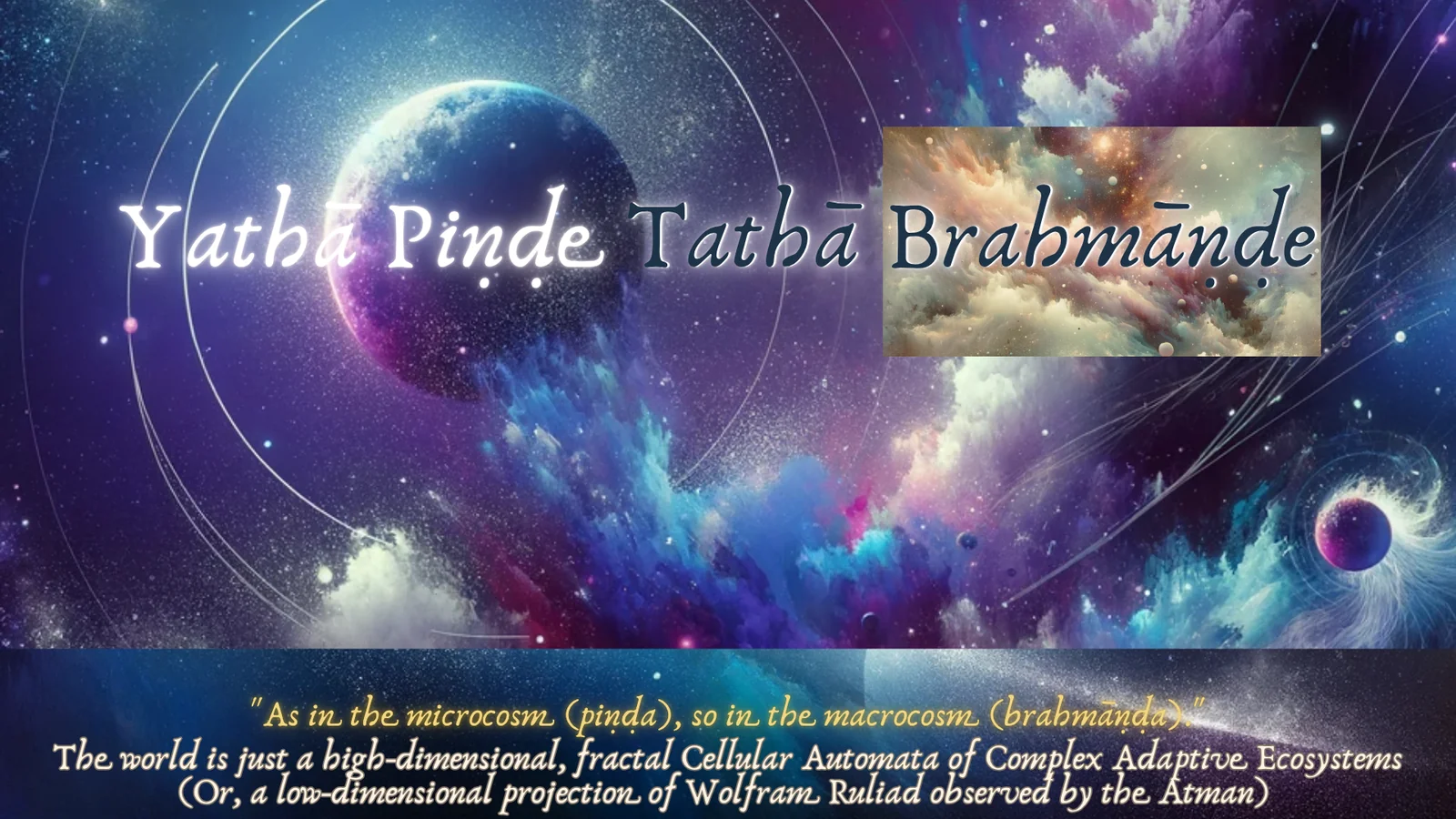
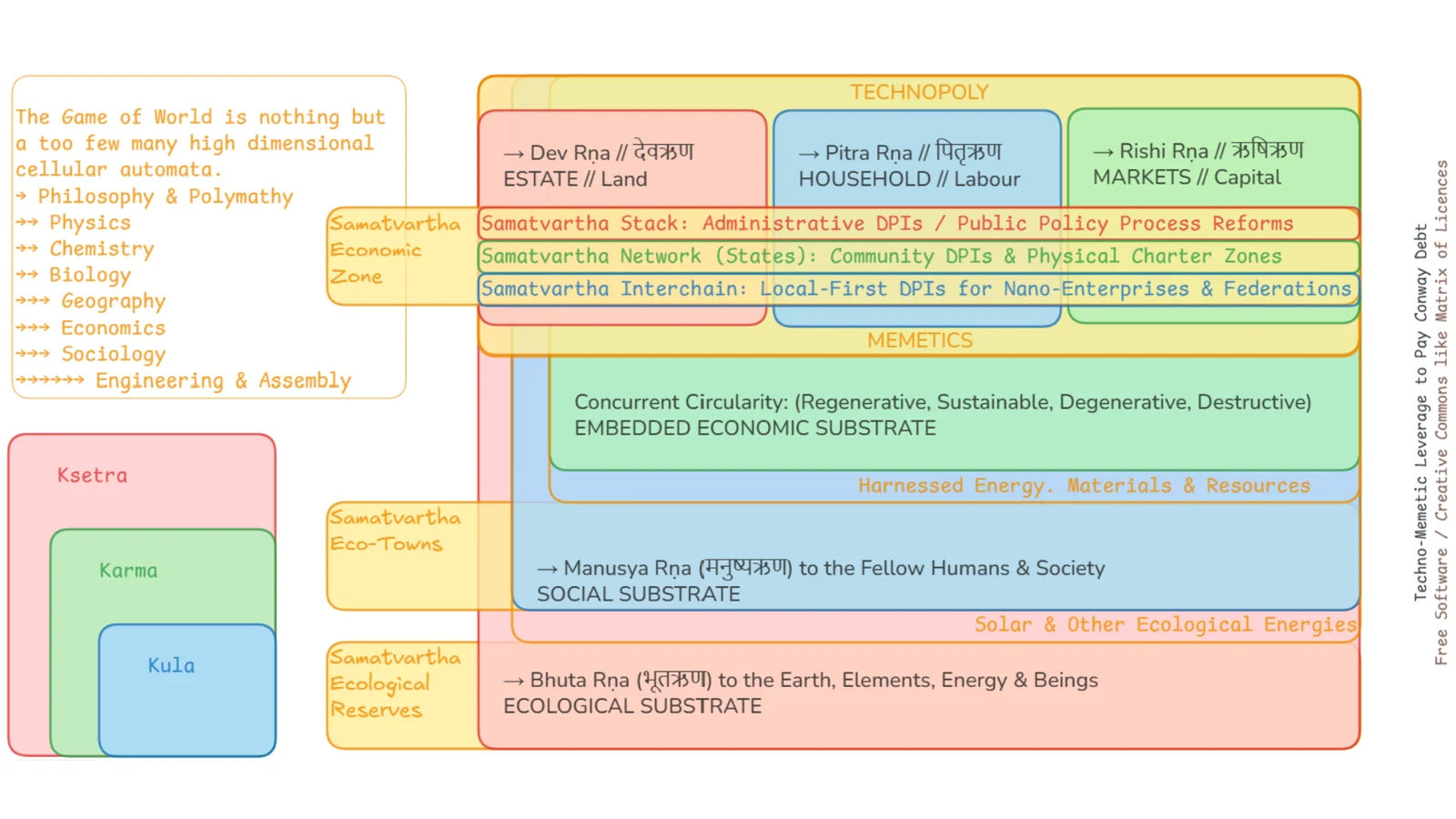
The world-model of Sāmatvārtha — economy nested under society, society nested under ecology, ecology nested under the rhythmic substrate. Read with the master essay.
Open at the deck →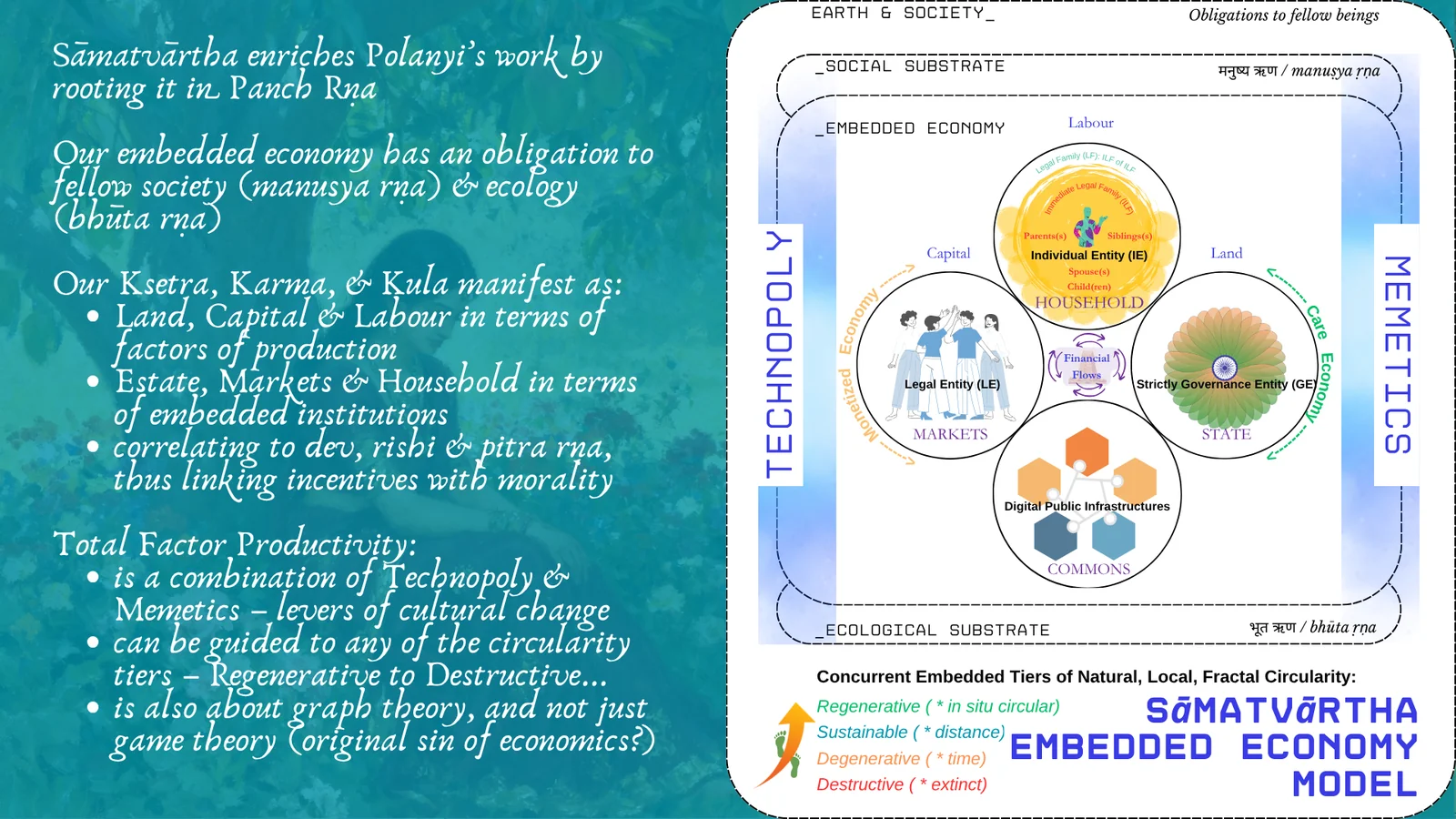
The distributional inversion. The point is not to worship the unicorn metric, but to beat it on its own arithmetic without accepting its value theory: federated prosperity, family-scale enterprise, commons-shaped licensing.
≈₹10,000 Cr distributed across 10,000 families. The same arithmetic, distributionally inverted.
10K proprietors × ₹12L × 8× earnings ≈ ₹9.6K Cr. India Stack + agentic AI + federated playbooks. Indicorns as the native form.
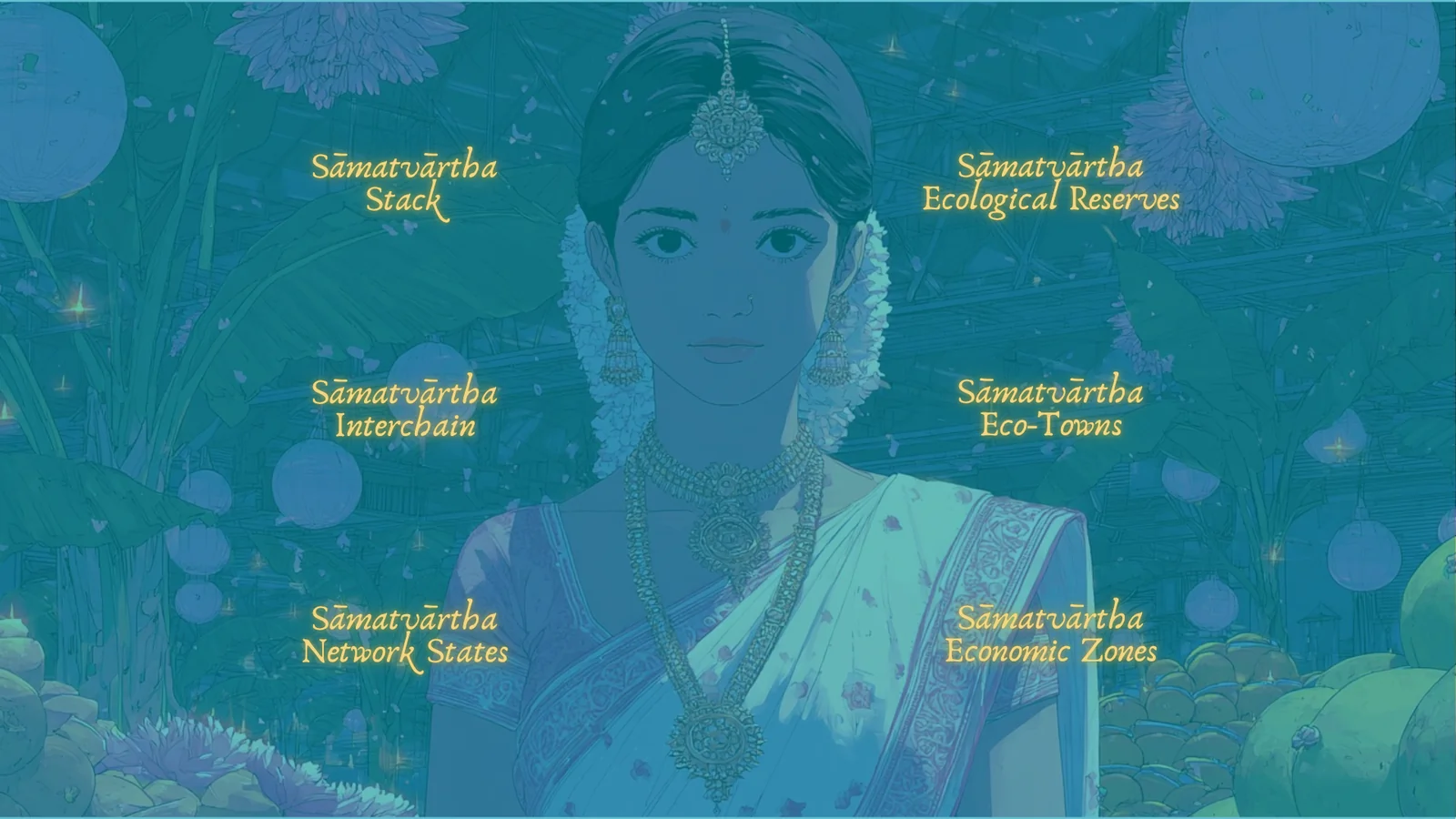
Reciprocity-enforced licensing for commons that cannot be strip-mined.
Obligation-shaped licensing on Ṛṇa. Universal copyleft with 45-day internal-use trigger. The Stewardship Mark.
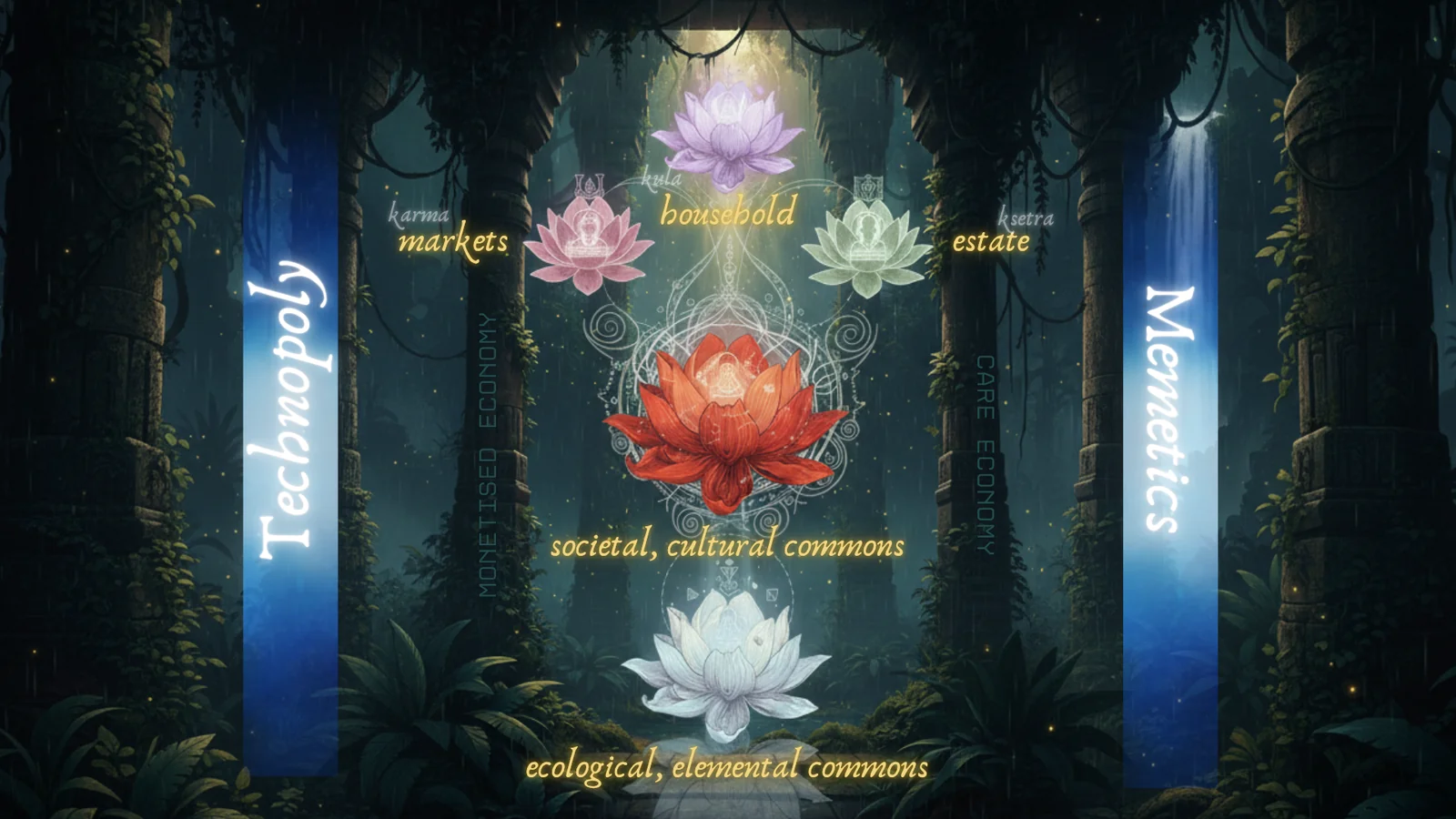
The translation layer. The Western diagnostic canon has spent 150 years naming failure modes the Indic frame can often name from older vocabulary. That does not validate the Indic frame; it makes the bridge legible in both directions.
The Schmachtenberger frame, named and met.
Generator function: exponential tech × Molochian incentives × captured sensemaking × finite substrate. The third attractor.
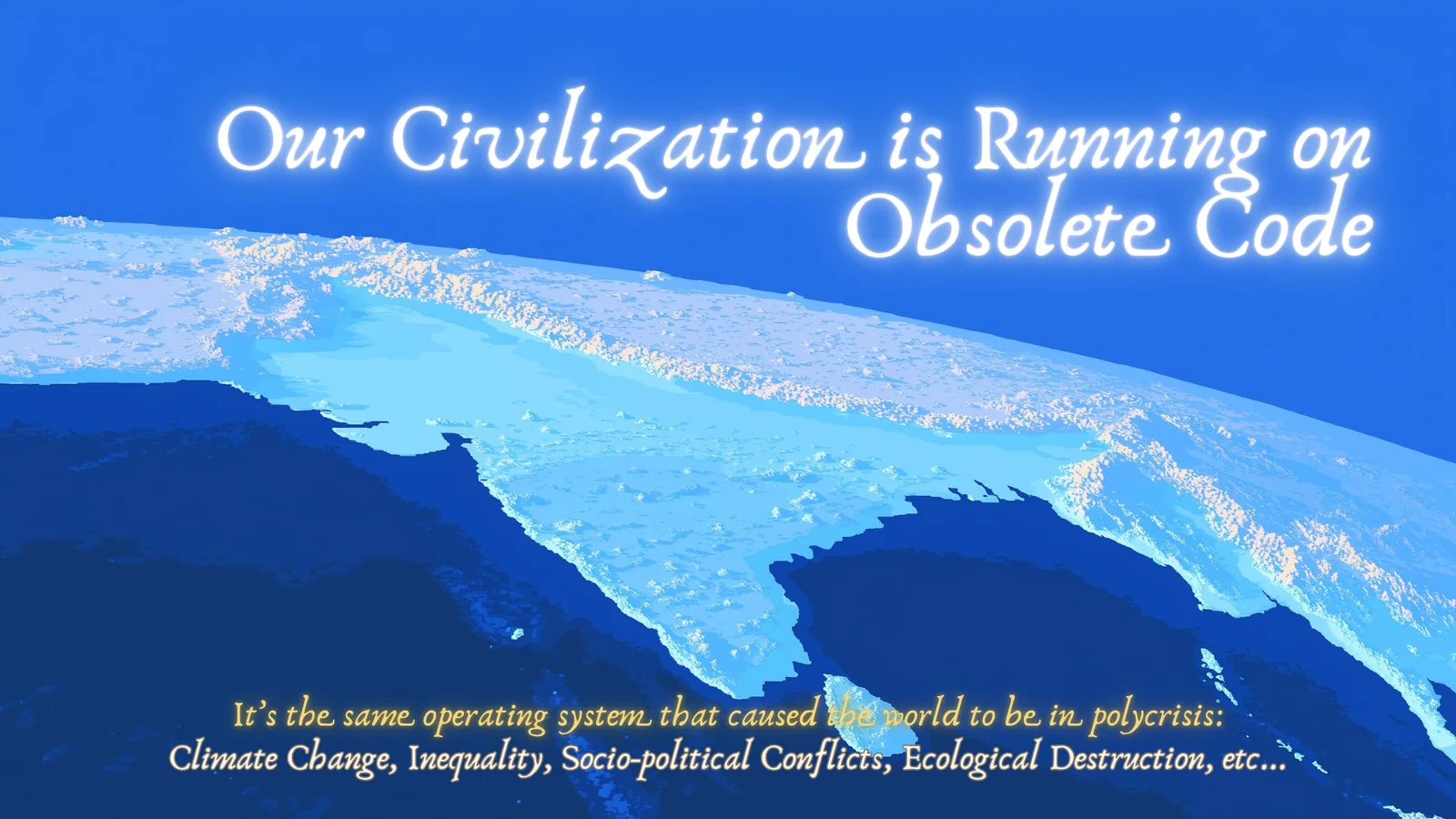
Coordination failure as a force, met by the rhythm it fails away from.
Ginsberg → Scott Alexander → the multipolar trap. Anti-rivalrous substrates. The dhārmika gene.
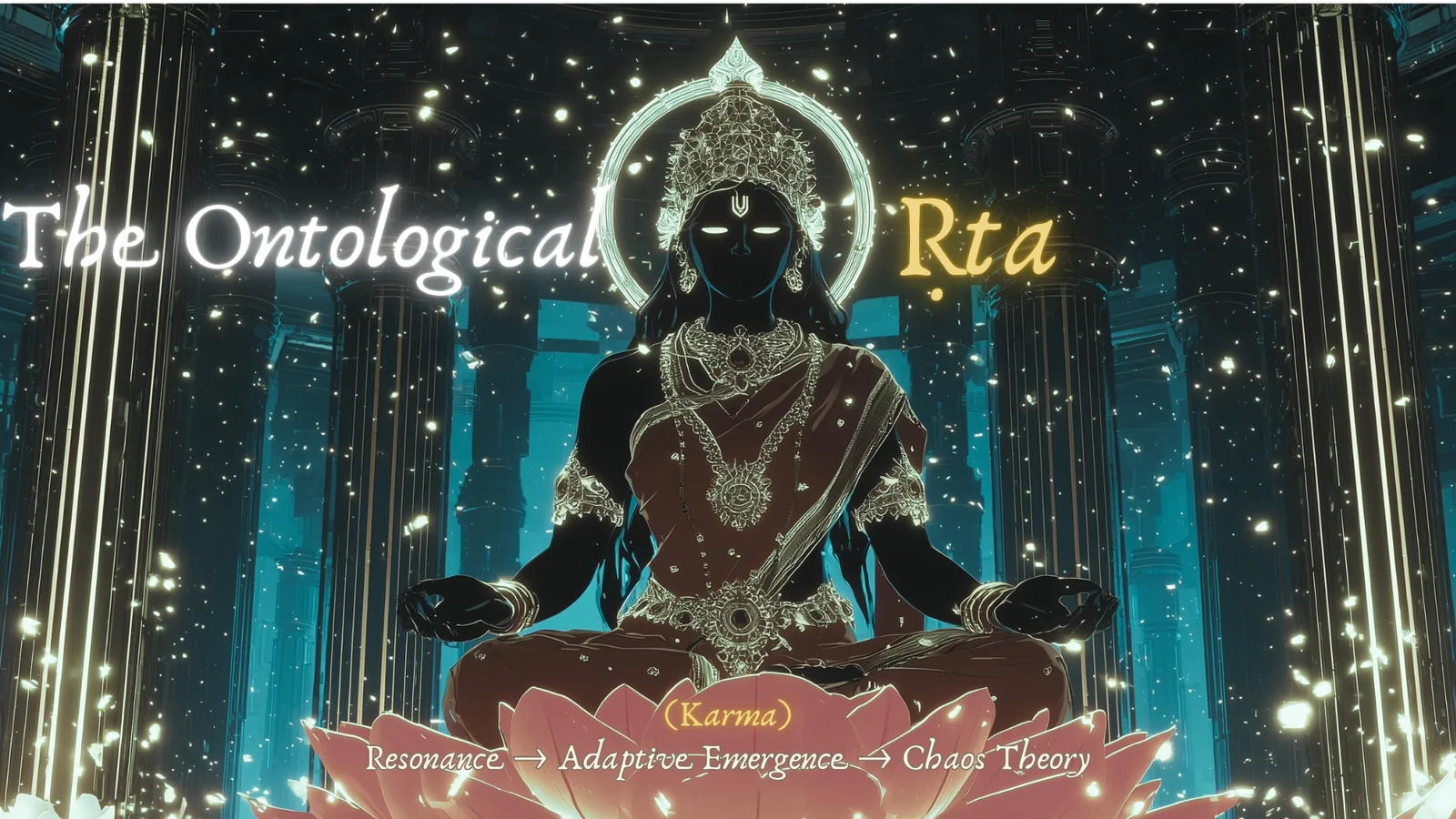
Twenty atomic essays on the most load-bearing diagnostic concepts the Western tradition has produced. Each linked to its primary source, each bridged to the Indic frame where the bridge holds. We are of commons belief — influences are named, not absorbed.
Why rational individual action keeps aggregating into collectively worse outcomes — and why anti-mimetic substrate is the design move.
When a measure becomes a target, it ceases to be a good measure.
The local exploit under every Moloch dynamic. The reason Pañca Ṛṇa ledgers obligations, not numbers.
The state sees only what it has made legible — and erases the rest.
High modernism + legibility + authoritarian capacity + weak civil society = catastrophic mētis loss. The deep ancestor of Goodhart.
Desire is not autonomous. We want what others want.
The attention economy is industrialised mimesis. Vairāgya is the cultivated discipline against it.
Coordination failure as a force, met by the rhythm it fails away from.
Same direction, deeper substrate.
Stop counting crises. Trace the upstream function generating them.
Exponential tech × multipolar trap × captured sense-making × misaligned values. The third-attractor design problem, named.
One generator function, many crises. Not a portfolio of problems.
Same direction, deeper substrate.
The orientation under which everything reveals itself as standing-reserve. The pharmakon character. The plural cosmotechnics that opens past it.
Gestell — the world as standing-reserve.
The forest is lumber-in-waiting. The human is human capital. The orientation under everything.
Technics can be grown from a civilisation's cosmology.
The master bridge — there is no single human technology. The philosophical permission for an Indic stack.
Every technology is simultaneously poison and cure.
The framework that makes sense of AI as the apex case. Dose, context, counter-discipline.
Past a threshold, institutions produce the inverse of their stated purpose.
Medicine makes sick. Schools un-educate. Cars immobilise. The conceptual ancestor of Conway Debt.
The surrender of culture to the technological frame.
Tool-using → technocracy → technopoly. When technology stops being a tool inside culture and becomes the frame culture is admitted into.
Markets do not just allocate. They constitute what counts as a good, a person, a relation. The lineage from Polanyi to Doctorow.
Labour, land, money — none were produced for sale.
The double movement is the structural counter-reaction. The fourth fictitious commodity is now in motion.
The value of land is created by the community; the rent is captured by the titleholder.
The Law of Rent, the Single Tax, and the unearned increment. The fiscal grammar of Bhūta Ṛṇa.
What counts as value creation, and what is rent-capture in disguise?
The production boundary, recovered. George's analytic move generalised to the contemporary economy as a whole.
Mechanism design, and the parts that survive the stress test.
QF earns its place; COST and migration-as-service do not. The Pañca-Ṛṇa stress test, in action.
A founding doctrine of modern consumer marketing.
Bernard London → Brooks Stevens → Packard → the Yayati pattern. Engineered desire, refined for a century.
Debt is older than money. Money is younger than markets.
The barter story is a myth. Civilisations that lasted had Jubilees. The structural ancestor of Pañca Ṛṇa.
A third of modern office work, by the worker's own private judgement, is pointless.
Flunkies, goons, duct-tapers, box-tickers, taskmasters. Managerial feudalism wearing capitalism's clothes.
Human experience as raw material. Behavioural surplus as feedstock.
Instrumentarian power. The substrate behind the platform stack and the AI stack alike.
The four-stage decay pattern of platform businesses.
Good to users → good to business → good to shareholders → dead. Adversarial interoperability is the lever.
What the mind is doing. What is being done to it. What the alternative looks like as a cultivable discipline.
Propaganda in technological societies is structural, not exceptional.
Pre-propaganda is the substrate. The educated are the principal target. Viveka, vairāgya, pramāṇa as cultivated reply.
The emissary captured the master.
The West has been operating left-mode dominant past the point at which the broader mode could correct it. Pramāṇa is the alternative.
The achievement-subject exploits itself.
Depression and burnout are the predicted output of neoliberal positivity. Vairāgya and āśrama as the operating discipline.
The alternative to acceleration.
A responsive, attuned relation that structurally cannot be optimised for. The closest Western parallel to rasa.
The planet is finite. Complexity has a price. The crisis is larger than cognition can hold. And the architecture has to handle that.
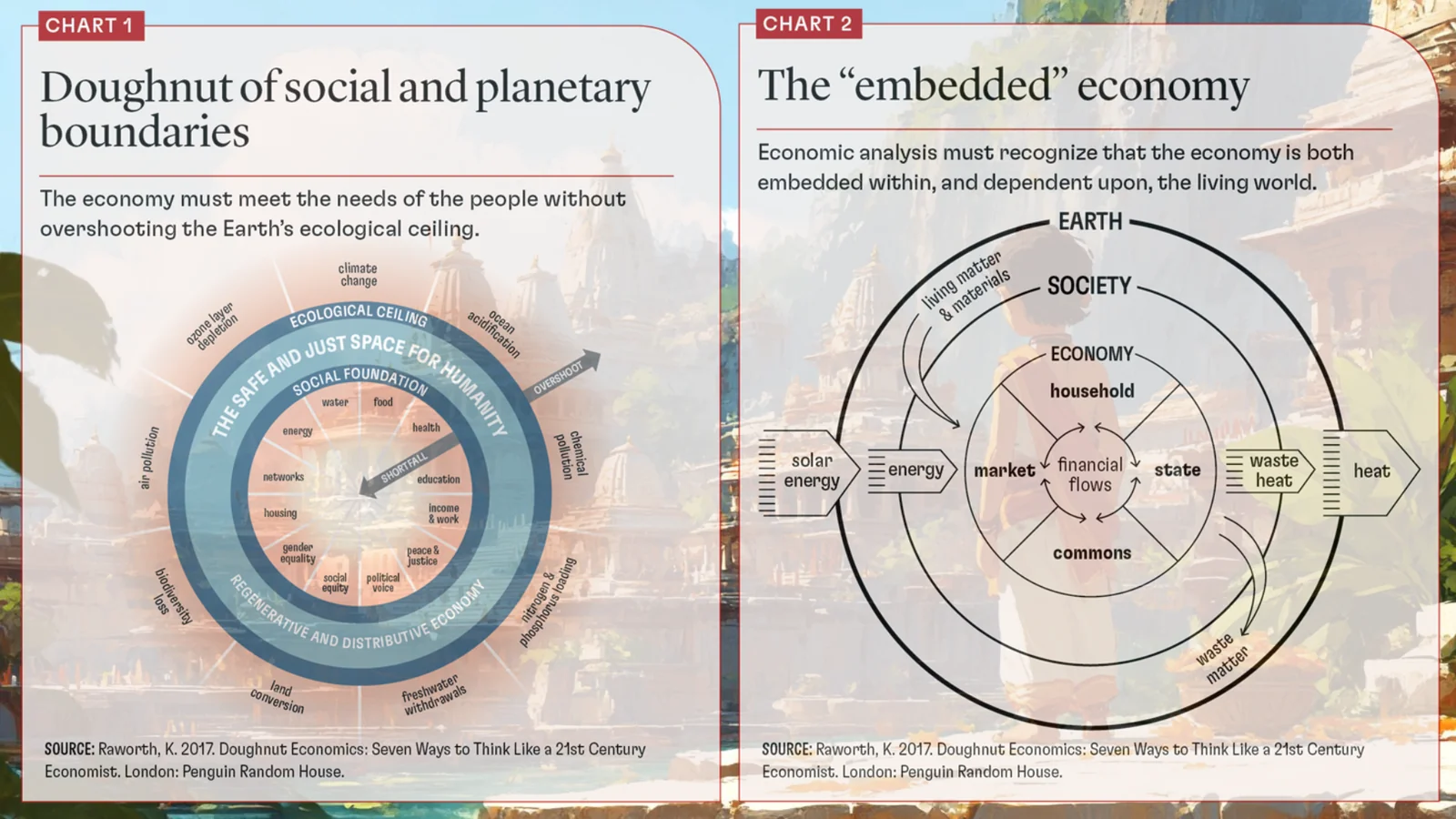
A safe and just operating space.
Between a social floor and an ecological ceiling. The most operational contemporary alternative to GDP-growth.
The eight design principles for durable commons.
One of the strongest empirical sciences of Moloch-resistant institutions. The structural backbone of TMC.
Objects larger than cognition can hold.
Why the metacrisis remains perceptually difficult even when fully named. Indra's Net was already a map.
A clear East-West bridge in the canon.
Right livelihood, dignity of work, sufficiency. A major ancestor of regenerative-economics movements since.
The economy is a community of beings, not a market of commodities.
Monocultures of the mind precede monocultures of the field. Seed as commons. The Indian voice on the bench.
Twelve places to intervene in a system, ranked.
Paradigm is near the top. Almost no policy work happens at that level. The Codex is paradigm-level work.
Diminishing returns on complexity.
Each new layer costs more and solves less. Marginal returns go negative. Conway Debt with archaeology.
Planetary computation as a new sovereignty.
Six layers. Post-Westphalian. The cosmotechnical counterpart to the Indic three-strata.
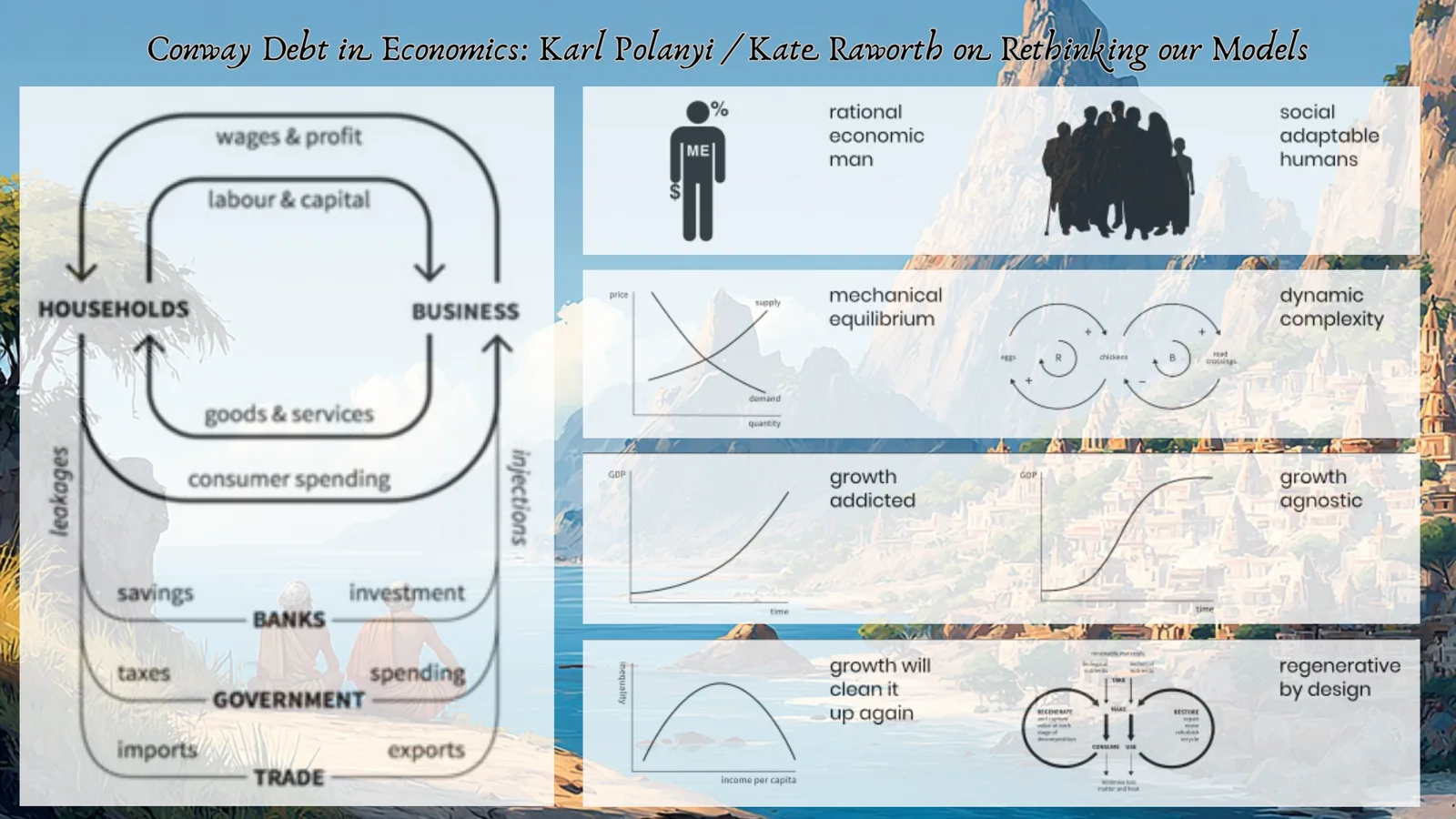
Every org chart was a snapshot of conditions that no longer hold. Layered on top of itself for decades, the residue compounds. The diagnosis is older than its name — see Conway Debt, with Tainter and Illich as the archaeological backing.
Open at the deck →
Early versions of this thesis were published pseudonymously at Just Publish It Already and on Brhat. Under the author's own name (Nilesh Lahoty), earlier articulations on LinkedIn document the evolution:
For Indic civilisational thought outside the colonial-academic frame — Brhat, Pragyata, Upword are the contemporary working platforms. We do not pretend Wikipedia is authoritative on Indic material; the canonicals on individual essay pages link to it because it is a stable English-language surface, not because it is reliable on the substrate.
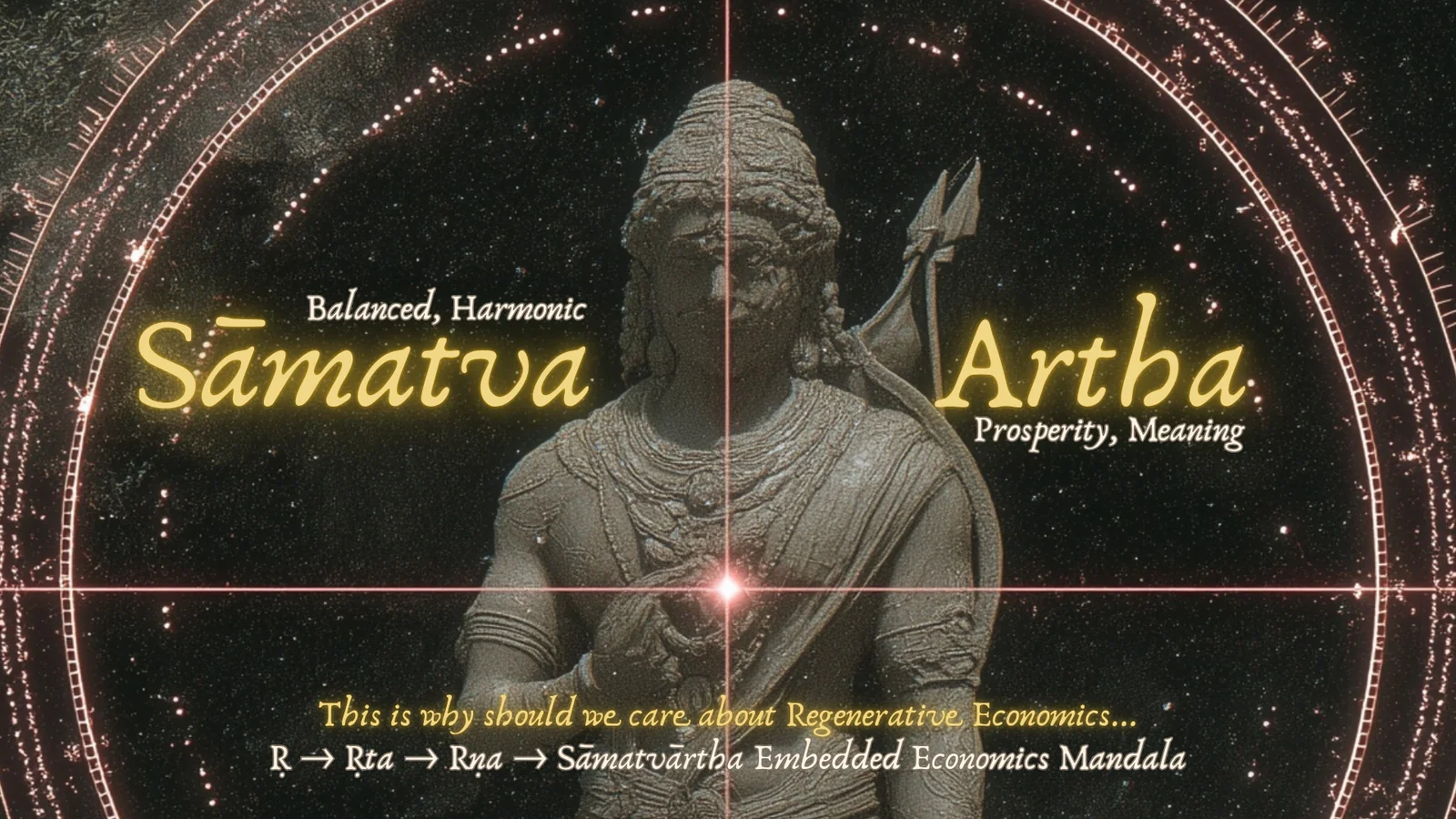
The Codex is being built in public. If something here lands — as builder, as reader, as collaborator — write in. We'll be honest about whether there's a fit, and if there isn't we'll point you somewhere useful.